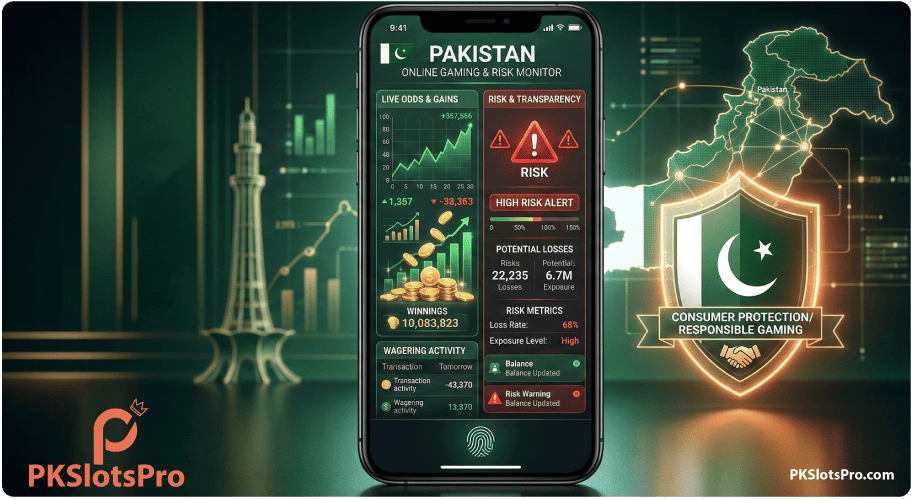
Online gambling is no longer a fringe digital activity in Pakistan. Over the past few years, mobile-first casino apps, offshore betting platforms, and so-called “earning games” have quietly expanded their reach through social media, influencer marketing, and encrypted messaging channels. Yet despite this growth, public understanding of how these systems actually work remains limited.
This knowledge gap creates risk.
In markets with formal regulatory frameworks such as the UK or Malta consumer protection standards, licensing disclosures, and responsible gaming tools are more visible. In Pakistan, however, gambling exists in a legal grey area. There is no dedicated local regulator overseeing offshore platforms targeting Pakistani users. As a result, users are often exposed to complex bonus mechanics, opaque payment systems, and misleading marketing without structured public education.
This article examines why public education and risk transparency matter in Pakistan’s online gambling environment. It explains the mechanics behind gambling systems, clarifies common misconceptions, and outlines the financial and psychological risks involved. The goal is not to promote gambling but to encourage informed awareness and responsible decision-making.
The Legal and Regulatory Landscape in Pakistan
Gambling laws in Pakistan are rooted in older legislation such as the Prevention of Gambling Act (1867), which primarily addresses physical gambling houses. Online gambling, particularly offshore digital platforms, is not clearly regulated under a modern, technology-specific framework.
Legal Ambiguity
- There is no locally licensed online casino regulator.
- Offshore operators may claim international licenses.
- Pakistani users typically deposit via local fintech services or third-party processors.
This creates uncertainty around:
- Consumer protection rights
- Dispute resolution
- Data privacy safeguards
- Withdrawal enforcement
When a user deposits funds into an offshore platform, they are effectively relying on the operator’s own internal rules rather than a Pakistani legal authority.
Educational platforms that explain these realities help users understand the structural risk before engaging.
How Online Gambling Systems Actually Work
Public education must begin with mechanics.
Many users approach online gambling with assumptions shaped by advertising: “high win rates,” “guaranteed bonuses,” or “predictable patterns.” In reality, most casino systems operate on probabilistic models.
Random Number Generators (RNG)
Slot games and digital casino titles use RNG software to generate outcomes. Each spin is independent. There is:
- No memory of previous results
- No pattern you can track
- No guaranteed “due win”
The house edge is mathematically built into the game design. Over time, this ensures that the operator retains a statistical advantage.
House Edge Explained
The house edge represents the average percentage of each wager the casino expects to keep over the long term.
For example:
- A slot with a 96% Return to Player (RTP) theoretically retains 4% over time.
- That 4% is the house edge.
Short-term wins are possible. Long-term profitability for the average user is statistically unlikely.
Without transparent explanation of these mechanics, users may misinterpret randomness as skill or strategy.
The Psychology of Gambling: Why Education Matters
Gambling systems are designed to sustain engagement.
Variable Reward Schedules
Intermittent rewards (occasional wins) reinforce behavior. This is similar to psychological models observed in behavioral conditioning research.
Small wins can:
- Offset perceived losses
- Create illusion of momentum
- Encourage continued play
Loss Chasing
One common behavioral risk is “loss chasing”—increasing bets after losses in an attempt to recover funds.
Education helps users recognize:
- Cognitive biases
- Emotional triggers
- Risk escalation patterns
Without awareness, these patterns can develop into problematic gambling behavior.
For deeper analysis on addiction risk signals, see: gambling addiction help in Pakistan
Bonus Mechanics: Where Transparency Is Critical
Bonuses are often misunderstood.
Advertisements may promote:
- “100% deposit bonus”
- “Free spins”
- “No deposit rewards”
However, these offers typically include wagering requirements.
Wagering Requirements
A 100% bonus with a 30x wagering requirement means:
If you deposit PKR 10,000 and receive PKR 10,000 bonus:
You may need to wager PKR 600,000 before withdrawal eligibility.
This does not guarantee withdrawal. Losses during wagering can eliminate both bonus and original deposit.
Users unfamiliar with these mechanics may perceive bonuses as “extra money.” In reality, they are structured promotional tools designed to increase betting volume.
For a technical breakdown, see: wagering requirements explained
Payment Systems and Withdrawal Risks in Pakistan
Depositing is usually easier than withdrawing.
Pakistani users often deposit through:
- Easypaisa
- JazzCash
- Bank transfers via intermediaries
- Cryptocurrency
However, withdrawal friction may occur due to:
- KYC (Know Your Customer) verification delays
- Documentation rejections
- Sudden account reviews
- Payment processor restrictions
Since platforms are offshore, dispute resolution is complex.
Users should understand:
- Payment reversibility limitations
- Verification policies before depositing
- Currency conversion risks
For local payment mechanics, see: Easypaisa casino deposit and withdrawal in Pakistan
Misinformation and the “Earning App” Narrative
A growing trend in Pakistan is the branding of gambling platforms as “earning apps.”
This framing can mislead users into believing:
- Gambling is a stable income source
- Outcomes can be predicted
- Consistent profit is achievable
From a probability perspective, gambling is not an income strategy. It is a negative-expectation activity over time.
Public education helps correct this misconception by:
- Explaining variance
- Clarifying RTP vs real-life outcomes
- Differentiating entertainment from income generation
Offshore Licensing: What It Does and Does Not Mean
Many platforms claim licenses from jurisdictions such as Curaçao or other offshore regulators.
Users often assume licensing equals safety.
In reality:
- Licensing standards vary widely
- Enforcement mechanisms differ
- Complaint processes may not be accessible to Pakistani users
Licensing is better than none—but it is not equivalent to domestic regulatory oversight.
For further analysis, see: offshore casino licenses explained
Why Risk Transparency Improves Consumer Protection
Transparency serves multiple purposes:
- It reduces unrealistic expectations.
- It clarifies financial exposure.
- It supports informed consent.
- It strengthens digital literacy.
In an environment without strong local regulation, education becomes a substitute protective layer.
Risk transparency includes:
- Clear explanation of house edge
- Honest discussion of withdrawal uncertainty
- Disclosure of bonus complexity
- Recognition of addiction risk
Without these disclosures, users operate in informational asymmetry.
The Role of Independent Educational Platforms
Independent analysis platforms can:
- Audit claims made by gambling apps
- Break down bonus structures
- Explain probability mechanics
- Highlight red flags
They should not:
- Guarantee outcomes
- Promote specific operators
- Encourage participation
Editorial transparency and methodology disclosure are essential components of credibility.
For example:
Responsible Gaming Perspective
Gambling involves financial risk. It is not a guaranteed income source.
Users should:
- Set a fixed entertainment budget
- Never borrow to gamble
- Avoid chasing losses
- Take breaks after consecutive losses
- Monitor emotional state while playing
Warning Signs of Problematic Gambling
- Increasing bet sizes over time
- Hiding gambling activity
- Borrowing money to continue playing
- Gambling to relieve stress
- Irritability when not gambling
If these signs appear, seeking support is important.
In Pakistan, formal gambling addiction services are limited. Mental health professionals and general counseling services may provide assistance.
See: Responsible gaming tools in Pakistan
Age restriction: Gambling platforms typically restrict users to 18+ or 21+ depending on jurisdiction. Underage gambling carries additional legal and psychological risks.
The Broader Social Impact
Beyond individual risk, gambling expansion without education can lead to:
- Household financial strain
- Digital fraud vulnerability
- Data privacy exposure
- Informal debt cycles
Public education is not anti-gambling. It is pro-awareness.
A well-informed population is less vulnerable to:
- Manipulative marketing
- Unrealistic earning narratives
- Fraudulent clone apps
Frequently Asked Questions (FAQ)
The legal framework is unclear for offshore online platforms. There is no dedicated local regulatory authority licensing online casinos domestically.
From a probability standpoint, gambling has a built-in house edge. It is not a reliable long-term income strategy.
The house edge is the statistical advantage built into a game that ensures the operator retains a percentage of wagers over time.
No. Bonuses typically include wagering requirements that must be met before withdrawals are allowed.
Delays may occur due to identity verification, payment processor restrictions, or internal compliance reviews.
Licensing provides some structural oversight but does not guarantee dispute resolution or full consumer protection for Pakistani users.
Loss chasing, increasing bet sizes, emotional dependency, borrowing money, and secrecy are common warning signs.
Conclusion
In Pakistan’s evolving digital environment, online gambling operates in a space of legal ambiguity and informational asymmetry. Marketing narratives often emphasize opportunity, while structural risks remain underexplained.
Public education and risk transparency are not optional they are essential.
Understanding probability, house edge mechanics, bonus structures, payment risks, and behavioral triggers empowers users to make informed decisions. It reduces harm, clarifies expectations, and strengthens digital financial literacy.
Gambling is a high-risk financial activity. It should never be approached as an income solution. Transparent education is the first and often most effective layer of consumer protection.